Bitcoin Miner UAE: Buy, Host and Run It Right

A bitcoin miner UAE search often begins with a machine price and ends with a harder question: where will that machine run profitably, securely and continuously? An ASIC is only the revenue-producing component. Power delivery, cooling, uptime, maintenance response and visibility over daily performance determine whether it operates as an asset or becomes an expensive, offline box.
For an individual buying one unit or an operator planning a 150-machine fleet, the right route is rarely just finding the lowest advertised ASIC price. It is building an operating model that matches the machine, the power agreement and the level of support required.
What a Bitcoin miner in the UAE really involves
Bitcoin mining converts electricity and computing power into hashrate, giving the network a chance to earn block rewards and transaction fees. Modern Bitcoin mining is overwhelmingly ASIC-based because purpose-built machines deliver far more hashrate per watt than general-purpose hardware.
That technical fact makes the commercial calculation relatively clear, but not simplistic. A miner’s expected output depends on its hashrate, network difficulty, Bitcoin price, pool terms and uptime. Its cost base depends on electricity pricing, power loss, cooling, hosting, maintenance and the capital cost of the hardware.
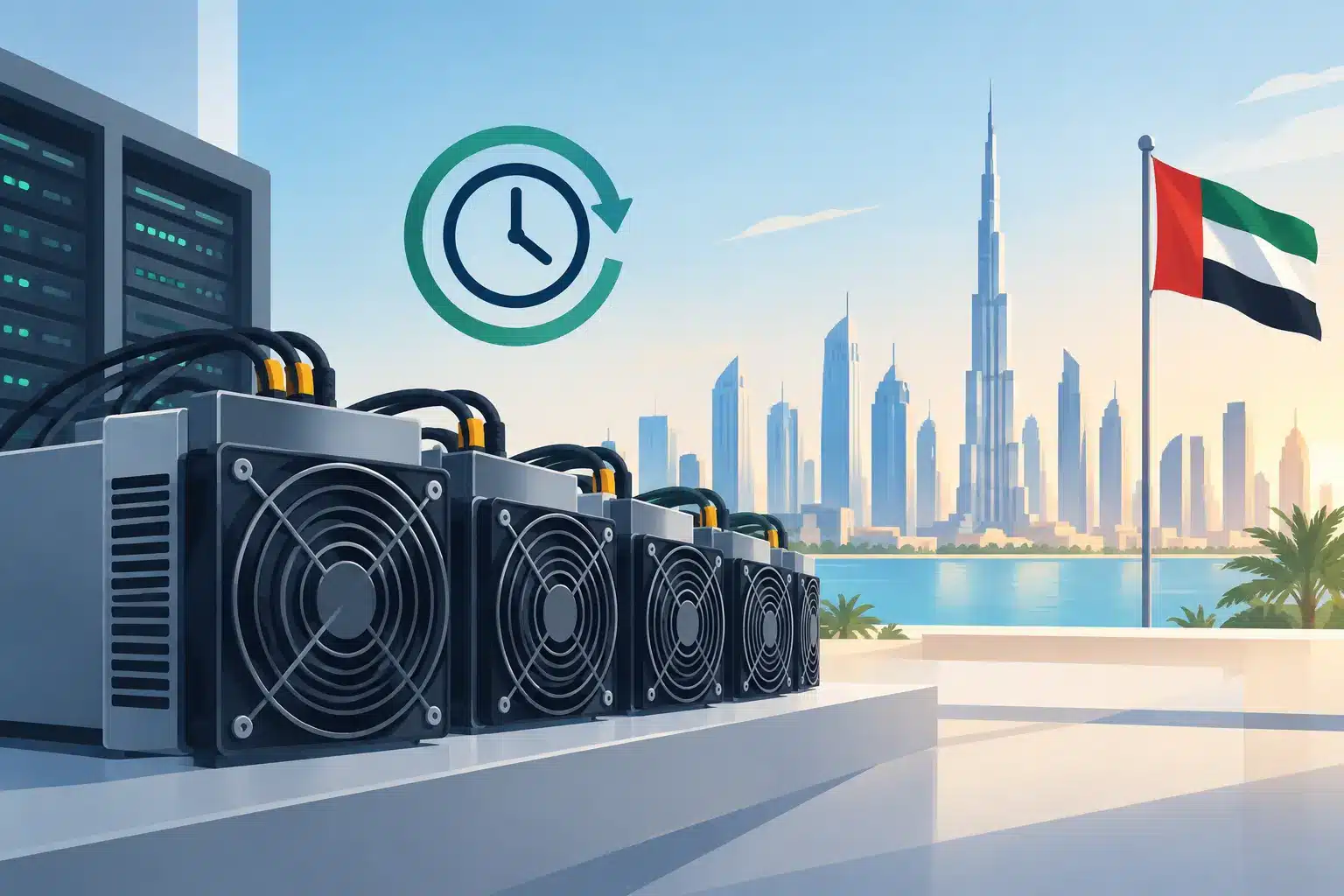
In the UAE, the operational environment deserves particular attention. High ambient temperatures make heat management a central infrastructure issue, not an afterthought. A machine that is correctly specified but poorly ventilated can throttle, consume power inefficiently or suffer avoidable component stress. Professional hosting turns this into a managed engineering problem through dedicated electrical design, airflow or hydro-cooling, monitoring and physical security.
Choose the ASIC around efficiency, not headline hashrate
Hashrate matters, but joules per terahash (J/TH) is often the more useful comparison. It shows how much energy a miner uses to generate each unit of hashrate. When electricity is a significant share of operating expenditure, a more efficient machine can produce a stronger margin even if a cheaper older model offers a tempting upfront price.
A current-generation air-cooled ASIC can be a sensible entry point for miners who want straightforward deployment and broad hosting compatibility. Hydro-cooled models can support greater density and more controlled thermal performance, but they require purpose-built infrastructure. They are a better fit for larger deployments or facilities designed around liquid cooling rather than a casual upgrade for a single machine.
Before committing, compare the quoted hashrate, power draw, efficiency rating, warranty position and expected delivery timing. Also ask what happens after delivery. A machine without racking, commissioning, network configuration and ongoing support is not yet mining.
New versus used equipment
New ASICs generally provide stronger efficiency, manufacturer warranty coverage and a longer competitive operating window. They also demand higher Capex. Used machines can reduce the initial outlay and may work well when power is particularly competitive, but their condition must be verified and the repair risk priced into the decision.
There is no universal winner. A new fleet may suit an investor prioritising predictable performance and long-term efficiency. A tested used fleet may suit an experienced operator who understands repair cycles and has access to low-cost power. What should not be compromised is inspection, transparent specification and a defined maintenance route.
Hosting is the operating system behind the hardware
Self-hosting may appear attractive because it gives direct control. In practice, industrial ASICs create demanding requirements: sustained electrical load, substantial heat, noise, dust control, reliable internet, safety systems and someone ready to act when a fault occurs. For most investors, these responsibilities outweigh the perceived savings.
Managed hosting places the machines in a facility built for continuous operation. The provider handles installation, power allocation, cooling, network connectivity, surveillance and day-to-day technical intervention. This lets the owner focus on asset performance rather than site operations.
A credible hosting arrangement should make the commercial terms easy to understand. Electricity pricing should be clearly stated, whether it is a fixed all-in rate or a structure linked to a power purchase agreement. Clarify what is included in the hosting fee, how billing works, whether there are minimum commitments, and how downtime or planned maintenance is handled.
The difference between a low advertised rate and a good operating offer can be substantial. A fraction of a cent per kWh may matter, but so can curtailment policy, transformer capacity, cooling design and the response time when a hashboard fails. Uptime is not a marketing word when every offline hour directly reduces potential output.
Questions to ask before selecting a Bitcoin miner UAE provider
The best providers answer operational questions with specifics rather than broad assurances. Ask which ASIC models they can source and whether the quoted units are in stock, allocated or subject to future delivery. Confirm where machines will be hosted, how quickly deployment can begin after payment and what commissioning process is used.
For security, establish who has access to the equipment, how assets are labelled and inventoried, and whether facilities have round-the-clock monitoring. For performance, ask how often the machines are checked, what monitoring data you can view, and what happens if hashrate drops below expectations.
Repair policy is equally important. Fans, power supplies, control boards and hashboards can fail. A practical provider has diagnostic capability, access to parts, clear repair authorisation and a process for returning a machine to service quickly. Delays in communication are costly even when the repair itself is uncomplicated.
Finally, confirm how scaling works. A one-miner client may later want five machines, and a successful fleet may grow from 50 units to several hundred. The provider should be able to add capacity, advise on hardware mix and provide reporting that remains useful as the operation expands.
Model the economics before you buy
Mining returns move. Network difficulty can rise, Bitcoin’s market price can change quickly and transaction-fee conditions vary from block to block. Treat profitability figures as scenarios, not promises.
Build a simple model using the machine’s hashrate and power draw, your all-in electricity cost, hosting charges, pool fees and an allowance for downtime. Then test the result against lower Bitcoin prices, higher difficulty and a period of reduced uptime. If the case only works under an optimistic scenario, the investment is too exposed.
For fleet buyers, separate Capex from Opex. Capex includes ASIC acquisition, logistics, installation and any site infrastructure. Opex includes power, hosting, repairs, pool fees, monitoring and administration. This separation makes it easier to calculate payback expectations and compare an owned fleet with cloud-mining exposure or a dedicated data-centre build.
Mining is also an asset-management decision. Some investors sell mined BTC regularly to cover Opex; others retain a proportion of production based on their broader Bitcoin view. The right policy depends on liquidity needs, accounting treatment and risk tolerance. It should be decided deliberately rather than improvised after the first invoice.
Monitoring turns a fleet into a managed portfolio
Whether you own one ASIC or 1,000, you need more than a payout figure. Effective miner-management software should show real-time hashrate, worker status, temperature, power consumption, alerts and historical performance. At fleet level, it should help identify underperforming units before a small issue becomes days of lost production.
Transparency matters because it lets owners distinguish a network-wide change from a local fault. If pool income declines while hashrate remains stable, the cause may be difficulty or price conditions. If one machine’s hashrate falls, the issue is more likely operational and should trigger inspection.
BitHash approaches this as end-to-end infrastructure: hardware sourcing, fast deployment, UAE-based hosting, 24/7 monitoring and repair support under one accountable operating model. That structure is valuable because the handovers between seller, logistics company, hosting site and repair technician are where many mining projects lose time.
Start with a deployment plan, not a purchase order
The strongest mining decisions begin with the desired operating outcome. Define your budget, preferred exposure, target scale, acceptable electricity cost and whether you need air-cooled or hydro-cooled capacity. From there, select ASICs that fit the economics and a hosting model that protects uptime.
A bitcoin miner UAE operation can offer a practical route into Bitcoin mining, but only when the infrastructure is as carefully chosen as the machine. Buy the hashrate, certainly, but give equal weight to the people, power and processes that keep it producing when conditions get demanding.
Written by BitHash Editorial
BitHash Infrastructure & Mining Research Team